• Babies in Bottles

    Lured to the streets of a lay-over city,

    a place foreign to my soul, a mob

    of askant stares, titillated expectancy,

    shrill hawking of flesh and wares,

    and placards enticing, promising all;

    I walked halls narrowed by sideshow trite:

    latex attempts at grotesquerie, cast horrors,

    a two-headed this and a five legged that,

    the longest, thinnest, the nastiest things.

    Quickly contrite, I sought an out-door,

    but down-cast eyes led me astray into

    the dim, sad light of a smaller corridor.

    Each bottle hovered in its own alcove.

    Suspended by and washed by, so slow,

    a stainless, sterile sluice, a gentle sate,

    each “malfeasant of nature” each

    “quirk of fate” slept in its own forever.

    Each baby was lite for affect and show:

    a stunted webbed limb, a bulbous head,

    a truncated body without appendage,

    a Cyclops, a hermaphrodite, a Hydra;

    each a double handful of sorrow for show.

    By what were these unions frowned upon:

    a gene glitch run rampant, toxicosis,

    a gods punishment, or mans violence?

    A cause cries for blame for through

    the particled sate a delicate eyelid,

    a perfect toe, alludes to original joy,

    though fleeting, of a life proposed

    but not realized or ordained, but taken.

    Who or what along the blade of existence

    nixed this one or that one or that?

    What were their sins condemning them

    to naked display with stitched scars

    of exploration visible to see along

    the palest of blood freed flesh?

    And, where were their souls? Were they

    those vague entities of phosphorescent

    sheen locked in jars;…..fireflies

    snatched from night’s vitrine, stuffed

    beneath blankets in trunks in darken rooms?

    The phrases, “malfesasant of nature” and “quirk of fate” were taken from a poem by Robert Penn Warren.  I can not locate my copy of his collected works to give the poems title.  The origin of the idea is somewhat vague in my memory, but I believe it came from reading somewhere, several years ago, that some museum or commercial enterprise had put on a public display of deformed fetuses for whatever reason I can’t remember.  Needless to say, this bit of information affected me profoundly as I have worked on this poem over several years.  It is time to let it go.

  • The Visitation

    I held my father’s hand once more last night, but only in a dream. 

    I did not see his face or hear his voice or recognize a nod, but his

    ever-gentleness stood to sooth the unease of muddled senses.


    Almost thirty quick years have gone since I stood by his bed.

    Did I, at first, hold his hand? A white cloth, folded in half,

    lay over his mouth for moisture; rare tears traced crow’s-feet

    to his pillow and I, new to dying, wondered if he cried from fear. 

    But through the muffling wetness, struggling not to sob,

    “Your mother…”  And then I understood, “I will take care of her.”

    I promised; only then…I remember, now…did I take his hand.


    The hand I held last night was not that of thirty years before;

    his hands, in life, had the square bluntness of his days of labor.

    Always, he carried a pocketknife to turn the grease and grit

    from beneath his nails into minute, curled strings of grime.

    The hand I held in my dream was only his because I knew

    and not recognition by touch; the hand I held was feminine,

    covered with the sheltered, thin skin of one needing protection.


    I’ve pondered the paradox for days, wondering why the hand

    was his, but not; time could not have altered to such extreme,

    a touch etched in memory.  Believing only in our faulty minds,

    I can only conclude that I, so desiring that my father

    might know I have kept my promise, conjured a dream,

    a visitation; the hand I knew as his is my mother’s I hold today.

    This is new, written over a couple of days and based on a real dream.  I tend to overwork things until I have removed any sense of freshness and spontaneity which they might have contained, so, I’m trying to work on that. Only within the last couple of years have I experienced dreams about real people.  This is new for me; aging not only changes our bodies but our perceptions and, apparently, our subconscious musings.

  • Delight in knowing

    There’s a simple delight in knowing

    a grackle in flight by the tilt of his tail

    or an iambic line by its sweet flow.

    There’s simple delight in knowing

    how to string and break beans or

    that a child can’t feign affection.

    There’s simple delight in knowing

    that its ciphering itself that counts

    and not the sum of the equation.

  • scars

    Daylight, unforgiving and true,

    caught my hands at ease, flat,

    unflatteringly flat, upon my knees.

    Loosely applied over blue-veined

    rivers and tendon ridges, a pliant

    skin reveals a history of scars:

    puckered, punctured stars, sliced

    crescents, rude tears and gouges

    all ungulate in a lighter hue over

    blue-veined rivers and tendon ridges.

    A skinscape of a crazed topographer;

    a delineation of years of labor,

    of incidences with sharp edges,

    of inabilities, and worst, inattention,

    of flailing arms and careless hands;

    hands with slender fingers

    better spread across opened pages

    gently tapping, counting, calling out the joy.

  • Stones

    Those we left by the road still stagger among us;

    we lean on their diminished bodies as we move.

    Talc-tasting air, smelling of urine and hot stone,

    burns our skin, shriveling our memories of them.

    The whisper has passed; this road is closed to us.

    This ditch of stubble will be our home for an hour,

    a day, forever, until this throng moves us,

    forces us up to walk, again, this endless road.

    Ahead, those green hills rejected our pleas.

    The distant canopies’ chattering fell silent,

    fell to fear, as we gazed, as one, with one breath held,

    and another stone was thrown to bruise the heart.

    This child on the sharp rack of my hip

    stares with eyes passive as stones.

    My child of bone in his gray flesh bag,

    stares passed wanting, never cries, only

    clenches the one ragged wall of his home.

    This was originally titled Refugees and was reproduced here with a few changes from a copy dated October, 2003
  • first poem

    first poem…a guttural moan of awe;

    an appreciation of phenomenon:

    of shimmers on febrile plains,

    of fallen cloud underbellies ripped,

    spilling mist to chattering canopies,

    of a sensuous line jerked from chaos,

    of beast in flight or majestic pose,

    of scents of the mull or heated stone,

    of the body in heat or love or both,

    of colors, so startling, only sky,

    in absolute stillness, could hold them.

  • Next Door

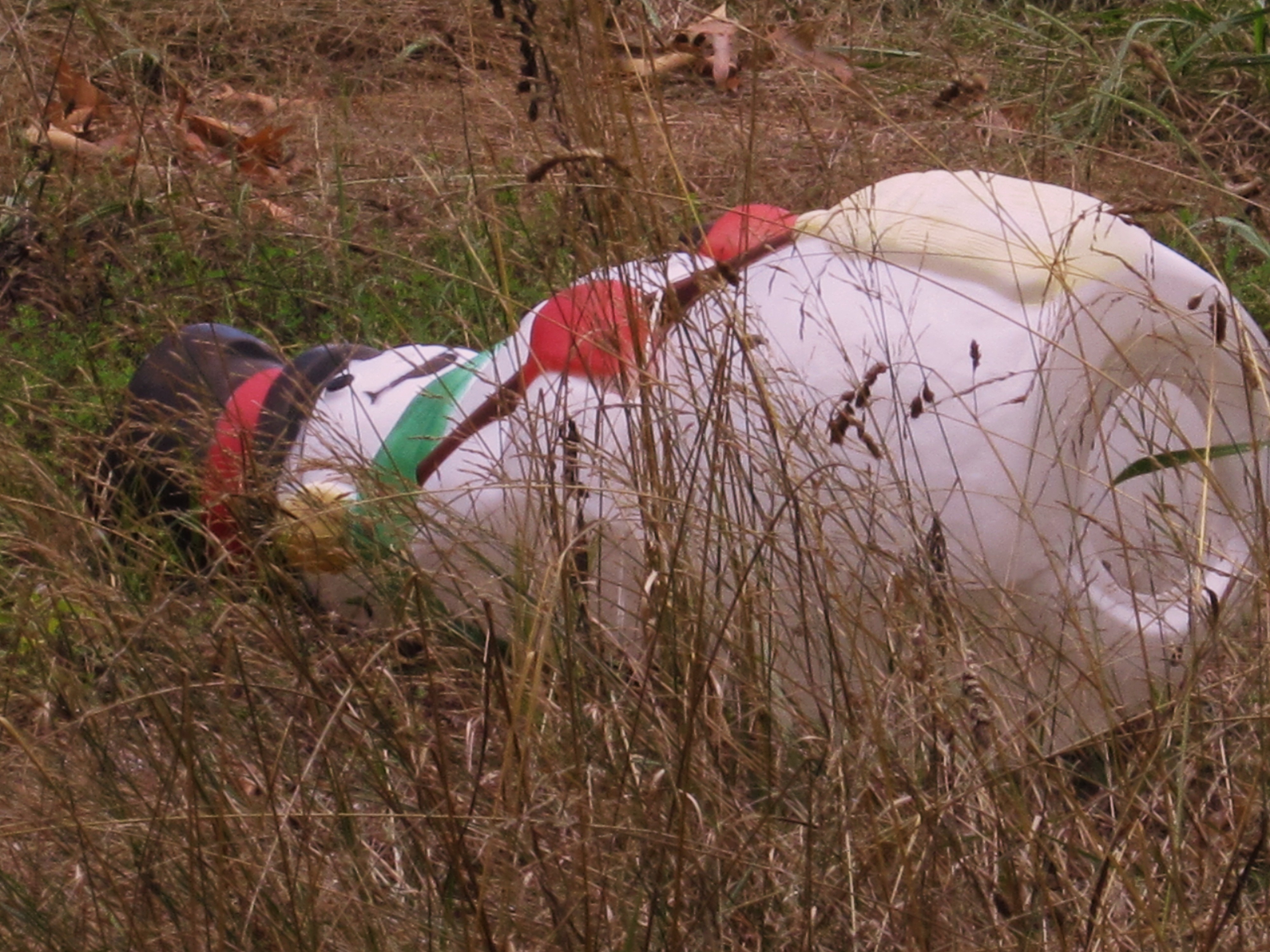
    Frosty 004 


    Across our mutual fence, salutations

    were swapped twice in three long years.

    one time, surplus tomatoes were offered

    and accepted but with visible unease;

    he looked as if I had presented bad fruit.

    His meek response, a nodding weak smile.

    In May, during a storm, a limb crashed

    across our fence; searching our canopies

    of oak, the origin was undetermined, so I

    claimed the splintered bough to chop & burn.

    No mention of the damaged fence. “O.K.

    and thanks.” he said, walking away, for good.

    In grass uncut six months or more, Frosty, 

    almost hidden from view by weeds long dead,

    sorely desires to melt away with all hope

    of retrieval loss.  Santa reclines on matted,

    desiccated grass, face turned from passerby;

    sun bleached now, but with a flush of shame 

    adding blush to fat cheeks of plastic mold.

     The wading pool, deflated, soldered tight

    to the ground by heat and grim, once rang

    with peals of childish glee, making me grin,

    from the kid I saw with Mom, herself,

    a large, redheaded girl, white as Frosty.

     Beneath two windows still sits the swings

    predictably askew.  Limp chains, devoid

    of seats, hang purely plumb, Heaven to Hell,

    perfect parallelograms aligning Here and There,

    Want and Need; impervious to debate or fault. 

  • Dying Pine

    The beetle-ridden column of pine, still

    coppery-brown—-stark against a flood

    of deciduous cousins’ May green,

    looms, surrounded by shedded, layered

    bark chunks and brittle limbs detached

    and dropped to litter his meager yard;

    precursors of the fall, numbered in

    days or months, unknowable, to come.

    Still, in wind, his stilted sway of youth,

    but now with creaks and groans of doors

    closing….opening, still offering his body

    to nuthatch, squirrel and the jay and still,

    though fading, his green crescent of a

    smile at his tip-top, unencumbered by

    regrets or daunting musings of mortality.

  • TC

    tc

    She’s gone for good this time…..I think.

    I’ve not seem her for seven days.

    Wet food collects slugs in her bowl; three days

    of rain evicting them from danky hidey-holes.

    That is the only sign. We rarely spoke

    ……or acknowledged the other.

    I did stoop to offer my hand, a back-arching lintel,

    ……….but not too often; no spoiling.

    She was a true hunter; eating her kill

    with no gloating, no display for display’s sake.

    She preferred the wild-wide-world, at least,

    that’s what I tell myself……as balm,

    but I really can’t know cat thought,

    or human thought for that matter.

    Others I’ve left to wander? Too aloof,

    too free with freedom, or has it

    just been easier to let them roam

    so blame can only know their names?

  • It Seems to me:


    Years ago, around forty actually, I had an American history professor who was memorable for two traits: he chain smoked in class and he used the phrase, “It seems to me…”, constantly.  His voice, whether from the smoking or a genetic occurrence, was deep and resonate and he used it to good effect.  His students were allowed to smoke in the small classroom with the only stipulation being that you disposed of your ash properly.  I used a coke can.  There was no mention of or consideration for non-smokers.  His use of the phrase, “It seems to me,” to preface almost everything he said seems to me to have been a sly ploy; one that worked.  The phrase implied, at least to me, “This is only my humble opinion and I only offer it for consideration.  I’m sure you have equally considered and viable ideas about…”.   I, for one, as a college freshman during the late sixties had few considered and viable ideas about anything excepting perhaps the Vietnam War, which I do not remember discussing in his class.  Its seems to me, by adopting that almost humble presentation, his ideas and points of view were much more palatable and acceptable.  No one likes to be preached to—-well, some people do and I never understood that.  Although I do not remember his name I can still–almost–see his leathery, creased face.  He was the only person that had any influence on me that first year of college; the only instructor I remember.  I’m sure he died years ago from lung cancer or emphysema.  Rest in peace.

     To make my point: it seems to me, there is an over abundance of discourse today that is manic-didactic and spoken with clinched jaws; the speakers might as well be wagging their fingers in our faces.  Some actually do!  Everything anyone says is open to dispute and usually is; jumped on and shredded before the last syllable dies in the air and I’m not just referring to political rhetoric.  I have wanted to do that, shred someones argument, but usually I just shake my head and mumble, “What a dumbass!” Since this is usually directed at an image on TV, no harm is done, no confrontation ensues.  If an actual person, friend or relative, utters something that raises my ire I attempt to smile quizzically and say nothing.  If you let them talk long enough without argument they usually smother themselves in contradictions and embarrassment. We must put our ideas and opinions out there whether they be about politics or chocolate-chip cookies but we have to realize we aren’t going to change many minds.

    My purpose for this blog is completely personal, completely selfish.  I don’t intend or really want to change anyone’s mind about anything; I want to clarify, for myself, my own ideas and opinions.  It seems to me, that is what I need at this point in my life.  Therefore, if I have the urge to express my “considered and viable ideas” in any form other than a short story or poem I will preface it with “It seems to me” and file it accordingly.

    Let us be considerate and thoughtful out there.